October 2012 ~ New Technolog Google Updates

Best SEO. SMM and SEM services Chandigarh

This is default featured slide 1 title

Go to Blogger edit html and find these sentences.Now replace these sentences with your own descriptions.

This is default featured slide 2 title

Go to Blogger edit html and find these sentences.Now replace these sentences with your own descriptions.

This is default featured slide 3 title

Go to Blogger edit html and find these sentences.Now replace these sentences with your own descriptions.

This is default featured slide 4 title

Go to Blogger edit html and find these sentences.Now replace these sentences with your own descriptions.

This is default featured slide 5 title

Go to Blogger edit html and find these sentences.Now replace these sentences with your own descriptions.

Monday, 29 October 2012

Penguin Recovering from Google


Jayson DeMers is the founder and CEO of AudienceBloom, a Seattle-based SEO agency, as well as Crackerize.com, a lyrics-humor website. Find him on LinkedIn or follow him onTwitter.
By now, you’ve probably heard about Google Penguin, Google’s major algorithm update that was launched in late April and wreaked havoc on thousands of websites, businesses, and the SEO industry.
Months later, many businesses are still in panic mode as they try to escape the depths of a Google Penguin ranking penalty. So, if your website remains in the clutches of this change, here’s what you can do to recover.

Step 1: Diagnose the Problem

Before doing anything, you need to diagnose the reason for your site’s ranking and traffic drop. The easiest way to discover if your rankings fell as a result of Google Penguin is to analyze your website’s traffic data. If your rankings (and traffic) took a noticeable dive on or around April 24, 2012, there’s a good chance it’s got something to do with Google Penguin. To get started, be sure to isolate your traffic data solely for Google organic search traffic, since this is the traffic source that Penguin would have impacted.
While traffic and rankings data provide strong evidence for a Google Penguin penalty, you can verify the results by performing an analysis of your inbound link profile. Penguin works, in part, by analyzing the inbound link profiles of every website. Penguin looks for links that appear to be manipulative and unnatural. The primary signal for an unnatural link appears to be the anchor text of that link. If a high ratio of your inbound link profile consists of non-branded identical anchor text, Penguin is likely to flag each of the links containing that anchor text as being unnatural. This results in a complete devaluation of all the links consisting of that anchor text in your inbound link profile. The devaluation usually results in a precipitous slide in rankings for each keyword with a high exact-match anchor text ratio.
So, what’s the threshold for a high exact-match anchor text ratio? There’s no one-size-fits-all answer, because Google’s algorithm adapts from niche to niche. However, as a result of some testing and dozens of inbound link profile audits, we recommend no more than 2% of your total inbound links should contain the anchor text for any one of your primary keywords, and no more than 20% of your inbound link profile should consist of exact-match keyword anchors.
This is a far cry from pre-Penguin best practices, when a 40% to 50% exact-match anchor text ratio was considered to be best practice. Sites that still contain this ratio, or higher, are considered “over-optimized,” which is why Penguin is also known as the long-awaited “over-optimization penalty.”

Step 2: Identify the Poison Links

Now that you know how Penguin works, you need to answer the following questions:
- Is your inbound link profile over-optimized?
To find out, start by gathering a list of your website’s inbound links. Two tools that can help you do this areMajestic SEO or Open Site Explorer. Majestic SEO usually has a larger index of links than OSE, which is why the following instructions are intended for use with Majestic SEO.
Run an anchor text report on your domain, and export the resulting CSV file to your desktop. Open that CSV and delete all columns except “AnchorText” and “TotalBackLinks.” Next, add a new column called “Percent of total” that calculates the percentage of that anchor text of the overall inbound link profile. The resulting output will look something like this:

In the above image, I have censored anchor text that contains the brand name of the company whose inbound link profile I audited. Note that there’s significant evidence of anchor text backlink manipulation.
- How much effort will it take to recover?
Next, highlight anchor text with a greater than 2% ratio. Links containing these anchors are the ones that are probably bringing your rankings down. They are probably also your target keywords. Check your site’s rankings in Google for these keywords. If you can’t find your site anywhere in the top 50, you’ve likely been hit by Penguin.
It can also help to create a visual pie graph of your data. It should look something like this:

If the largest four pieces of your pie aren’t branded anchors, naked URLs, or universal anchors (ie, “click here), then you’re much more likely to be susceptible to a penalty. In the example above, the link profile is heavily optimized and the website was hit by Penguin.
The more over optimized your link profile, the more work you’re going to need to do to recover from Penguin. To do this, you can take a two-pronged approach: delete and dilute. First, identify and delete the links that are hurting you. Then, dilute your inbound link profile with new links that abide by new link-building best practices.
-Which specific links are contributing to your Penguin penalty?
After you’ve visualized your backlink profile, it’s time to isolate the bad links from the good ones. To do this, isolate all the links containing anchor text that you highlighted in red. In Majestic, this is possible by simply clicking the anchor text within the “Top Anchors” section in the “Reports” area. (If you’re using Majestic for your analysis, be sure to turn off “domain clustering” for this analysis. )
Export the resulting list of links as a CSV to your desktop and sort them by ACRank (in Majestic) or MozRank (in Open Site Explorer). Highlight anything with an ACRank or MozRank of two or less. The highlighted links are the ones you should target for removal.

Step 3: Engage in a Link-Removal Campaign

Now that you’ve identified as many bad links as you can, it’s time to reach out to webmasters and ask them to remove your link. To find contact information for a webmaster, start by visiting the website and looking for a “contact us” page. If one doesn’t exist, you can try finding their information via WhoIs lookup. If you still can’t get their contact information, make a note in your spreadsheet that you were unable to find contact information for the website and move on to the next one.
When sending emails to webmasters, keep in mind that they have nothing to gain by complying with your request to remove your link. As such, be courteous and thoughtful with your request, and show your gratitude if they oblige.

Step 4: Start a New Link-Building Campaign

After you’ve completed your link removal requests, it’s time to begin a new link-building campaign, with the goal of “diluting” your inbound link profile so it falls within the realm of “natural” that Penguin is designed to look for. So, what are the elements of a strong, natural inbound link profile?
  • High domain diversity
  • High link type diversity (ie, web 2.0 sites, press releases, editorial content, blog comments, forums, etc.)
    High anchor text diversity
  • Lots of social signals (ie, Twitter tweets, Facebook likes, social bookmarks, G+1’s, Diggs, Stumbles, etc.)
Are you starting to see a pattern? The key to looking natural is simple: Diversify your tactics. Special consideration should be given to the anchor text that you use for your links. Safe and effective post-Penguin link-building anchor types include the following:
  • Branded anchors (ie, Mashable)
  • Naked URLs (ie, www.mashable.com, mashable.com,)
  • Universal anchors (ie, click here, here, visit this website, etc.)
  • Hybrid-branded anchors (ie, Social media news at Mashable)
Of course, great links start with great onsite content. Expertly-authored blog posts, valuable primary data analysis, controversial opinion pieces, and intriguing data visualization are some examples of great onsite content. If your business is in a “boring” industry, you may find this post helpful for developing a content strategy.
After you have some great onsite content, pursue an offsite link-building strategy. Here are some ideas for offsite link building:
  • Produce great content and syndicate it on niche-related blogs, web 2.0 sites, and high-quality article directories
  • Write press releases to announce developments with your company and distribute them via PR distribution services such as PRWeb
  • Reach out to influential blog authors in your company’s niche and offer to write guest posts
  • Leave insightful comments on relevant blog posts
  • Participate in industry-related forums
  • Syndicate your blog’s RSS feed to RSS aggregators
  • Create and publish images to Pinterest
  • Publish videos to YouTube
There are many tactics for getting new inbound links, but the reality is that they all take a lot of time. In today’s competitive online marketing landscape this effort is simply necessary.

This Person Has A “Huge Recovery” Story


Google has been pushing major updates left and right in recent weeks, and plenty of webmasters are feeling the effects for better or for worse. In late September, Google announced the EMD update targeting low-quality sites with exact match domains. Later, we found out Google had also rolled out a new Panda update around the same time. Business owners who saw their referrals from Google decline had enough fun trying to dig through that and determine which update they were actually hit by (this should have been easier for those who did not have exact match domains).
Before the dust settled on those updates, Google went on to announce a new Penguin data refresh on Friday, after months of anticipation. So far, we have not seen many recovery stories, but we have seen one. We also haven’t seen a whole lot of people claiming to have been hit by the latest refresh (though there have been some). We have, however, seen plenty who have been working on trying to recover from previous Penguin launches, but have not been able to please the algorithm this time around.
Have you seen changes from the latest Penguin data refresh? Let us know in the comments.
When Google’s Matt Cutts tweeted about the Penguin refresh on Friday, he said it would “noticeably” affect 0.3% of English queries. He later tweeted that the refresh would be completed that same night. That means that the effects of the refresh should have already been felt by any webmasters affected.
There has been at least one reported recovery from this round of Penguin. Marketer Donna Fontenot claims that she has one client that saw a “huge recovery”. Here are some comments she made on Twitter:

Bad Link Building Recovery After Google Penguin


I have seen a lot of people with link problems during the course of this year. Some of these have been companies that have gone really deep with bad linking practices. Lots of article directories, lots of directories, lots of paid guest posts, really bad anchor text mix ... well, lots of link building done for link building's sake.
Then 2012 came and the piper came calling. The bill was due, and they were either heavily penalized, or outright flushed from the index. For some, they were hit by Penguin. Others were hit by unnatural links messages, and some of these were followed by penalties as well.
Many of these companies have real people working at them, many employees, and their whole business got turned upside down. It's a shame really. Many of the impacted companies have good, genuine, people working for them, and they’ve been badly hurt.
Whether the participants were bad actors or not, Google is just acting to protect its business. For those who were penalized, the situation is dire.
Now the question is, can you recover?

The Recovery Process

Yes, you can recover. We have helped a few sites to get their penalty removed (not Penguin as yet, as there has not yet been an update to that algorithm).
Don't get me wrong, it was a painful process. For reference, I have written about parts of the process in two recent articles here on Search Engine Watch:
  1. 2 Quick Ways to Perform Bad Link Archaeology
  2. Simplifying the Task of Pruning Links
Those two posts should give you an idea of the some of the basic mechanics. In addition, here are some other things you should plan on doing when you begin work on cleaning up a bad link profile:
  1. Be exactingly thorough. At the very least, you need to look at each and every domain that links to you and make a call on whether it has bad links to your site or not. This is a binary decision – it's good, or it's bad. If it isn't in your good bucket, it goes in your bad bucket, and you're going to be requesting its removal.
  2. Be laser focused. Yes, it is all the rage to be mad at Google, but stay focused on your business. Most likely, you aren't going to sue Google, or participate in a mass outcry that forces Google to change what they are doing, so do the best you can to understand what it is you need to do, and sit down and do it. This is very, very hard to do because having your business damaged by the actions of a third party does make you angry. That just makes being focused much more important.
  3. Be harsh. As soon as you hear yourself justifying that a link really is a good link, you probably have a problem link identified. Good links need no justification, and no debate is required. Also, it is critical to get back to a point where you can simply focus on building your business as soon as possible. Don't waste your time and Google's cutting corners, otherwise this process can take a half year or more. Cut to the chase so you can move on.

How Much Work is This Going to be

We have seen situations involved more than one million links and 7,000 linking domains. Clearly this type of situation is going to be a lot of work. Those are big numbers but if you follow the process outlined in the Simplifying the Task of Pruning Links article you can significantly reduce the total effort. Nonetheless, we have seen projects of this size take 600 hours of work or more.
However, the bulk of the work can be done by inexpensive labor that you train to reognize the signs of a bad link. This will bring down the out-of-pocket cost considerably, and allow you to scale up the effort with multiple people. If you sit down and get right to it, you can push through the work in a reasonable amount of time.
Here's what a link recovery timeline might look like:
link cleanup schedule
Obviously, one of the easiest ways to connect with people to request a link removal is by email. You should certainly start there, and be prepared to make multiple requests. Don't stop there. If that hasn't proved sufficient, look for phone and snail mail contact info.
When making the request for a removal, be polite. You're asking someone to do something for you. Don't tell them that there spammy links ruined your business. Instead, be matter of fact about it. Something like:
Google has complained to us about some of the links to our site, and we fear that the link on your site to ours may look like a paid link. For that reason, we would like to request that you remove the link(s) from your site. The link appears on this page: http://www.theirdomain/pagewithyourlinkonit.html.
The same approach is the best in the event that you send a snail mail or make a phone call.
If you have been hit by Penguin, it now becomes a waiting game for you, and you need to wait for an algo update and hope for the best. This is one of the main reasons why I emphasized the need to be harsh. Better to over-remove and be in a position to move on.
For those who received an unnatural link message, or a non-Penguin based penalty, once your work is done, you will need to file a reconsideration request. Google's documentation on how to go about that can be found here. In addition to the advice you will find there, I would add:
  1. Don't complain about what happened to your business. Surely you've been hurt. But, the people receiving your request are required only to review the facts of your case in regards to the problems that were detected with your site.
  2. Provide solid documentation of the details. I like to keep the actual reconsideration request message reasonably short and then link to Google Docs with the details of the situation. For example, if there are links you were not able to remove and you want to ask Google to discount them, link to a spreadsheet that lists them all.
  3. Don't mention how much you spend on ads. This isn't a factor in this process either.
You can get more information on reconsideration requests in my interview with Google's Tiffany Oberoi.

How Much Will You Recover?

This is the million dollar question. Unfortunately, there is no simple answer.
Remember that some of the traffic you used to get from Google was due to the bad links that you have now removed. After you get a penalty removed, it isn't likely that you will get back to where you were at your peak.
How much the permanent traffic loss will be depends on what percentage of the link juice that used to drive your rankings came from bad links. One of our recent cases lost 25 percent of their traffic even after the recovery.
As a result, even recovery can be painful. But, once you have recovered you will be in a much better spot to drive the long term growth of your business.

SES Chicago
Want to Know the Hottest Digital Marketing Strategies for 2013?
Join hundreds of digital marketers and experts at SES Chicago, November 12-16.
SAVE $400 on an All Access Pass now through October 26. Register today!
  • Get inspired with a Keynote from Avinash Kaushik, Google's Digital Marketing Evangelist
  • Connect, share and get an in-depth education on SEO, PPC, social, analytics, mobile, and much more from the industry's leading practitioners
  • Explore evolving trends, opportunities and evolving technologies in digital marketing
There's still time to exhibit at SES Chicago. More than 80% of attendees play a key role in recommending and approving product and service purchases. 

Recovering from Google Penguin | Get Rid from Google's Updates


Your Guide to Recovering from Google Penguin
google penguin blastThe dust still seems to be settling from the Google Penguin fallout. While none of my other sites were affected, one of our ecommerce sites, Pet Super Store, was hit pretty hard. After spending weeks analyzing our link profile, determining spam vs. quality links, and looking at on-page factors, I’ve decided to share how I am recovering from Google’s latest visit to the zoo. I'm giving you the no holds barred (yes, all the embarrassing stuff) that most likely contributed to the site’s penalty and what I have done to try and fix it. No major wins yet, but we are on our way to a better and cleaner site profile that we can be proud of.
Two years ago, I purchased www.pet-super-store.com. When buying the company and during due-diligence, the previous owner had spent a good deal of time on SEO. The link profile had a lot of good quality links, tons of keyword based anchors, lots of content and article marketing and *really* great rankings on some of the top performing keywords in the space. I had a list of 500, 2 and 3 term keyword phrases that were ALL top 3 in Google. Here are a few ringers: dog bowls, dog beds, pet gates. All of which were #1 on Google, Bing, and Yahoo! and not just short term, for over two years before we bought it - in total - about four years.

Enter: The 2011 Panda...

google panda
Quick Stats:
  • 50% drop in Google traffic
  • 2500 unique visitors a day turned to 1200
  • The long tail basically disappeared
I still had top 3 or top 5 rankings for a bunch of terms, but all the long tail that was the highest converting traffic and represented the largest percentage of traffic was GONE. Immediately, I went through and removed thin content, edited low quality pages in terms of duplicate content, edited titles, meta descriptions, and checked for duplicate on page elements. I believe that a lot of Pet Super Store’s rankings dropped because of the high number of directory links, article links, and similar lower tier links the site had. As everyone knows by now, it wasn't so much about site penalized as the value of the links being passed to the site. Over time, my efforts were being rewarded and seemed to appease the Panda. Traffic was starting to recover.

Enter: The 2012 Penguin...Then Insert Foot Into Mouth

Quick Stats:
  • 66% drop in organic Google Traffic
  • 1500 unique visitors a day to 550
  • Lots of top ranking / high value terms dropped to page 2 or page 3 and some +100
So now we are dealing with what I'm going to call an up-side down pyramid. All the things that previously put us at the top of the search engines are now the reason we are at the bottom (ok... well penalized off the first page).

Snapshot Of Link Profile 4/20/2011

The Good
  • The site had 900+ linking root domains (shown in SEOmoz).
  • Previous owner bought a dog forum that had great authority as a community bolt-on.
  • Many links were from guest writers (before it was cool) with high quality unique content.
  • Decent link diversity with press release related links, high quality directory (yahoo etc), links from the brands we carried, and lots of niche pet sites.
  • Many links were contextual from the guest writing and nothing was spun (awesome).
The Bad
We had TONS of everything that lost value:
  • Directory links: All exact keyword anchors (which used to work).
  • Article marketing: Ezinearticles, HubPages, Squidoo, etc. (another one that consistently worked).
  • Site-wide links: Lots of "earned" blog roll links that were legit but now are marked as spam.
  • Reciprocal links: We had a page of links going to great sites to get reciprocals... now dead.
The Ugly
  • A couple years before I bought it (2008) the previous owner offered a free website hit counter that anyone could use that just so happened to drop a text link back to Pet Super Store. Literally hundreds of people used it on their sites such as blogger, wordpress, bravejournal, static sites, business sites, you name it there was a hit counter link back to our site. Since it is static code, there is no way to click a button and remove the links. Every one was an exact keyword anchor and "site-wide".
  • Almost every link we had was keyword anchor based so even the "good ones" were potentially hurting us as we had almost no brand related anchors.
  • That forum we bought, had a "block" of 6 text links rotating at the bottom of every forum post (1.5 million pages, yes, you read that right).
  • Directory Links: They did one of those "2000 directory link" packages with a low quality SEO service with the exact same anchor, description, etc (more on this later).
All Totaled Up, We Had A Cluster (Insert Expletive)

Here Is What We Are Doing To Recover (And Results From My Efforts)

First off, my day now starts off with a Monster energy drink because coffee just doesn't cut it, then I do one or all of these four practices:
  1. Remove/Replace crappy content on our site. There are about 1,500 products so this is not quick and it's a daily activity.
  2. Contact site owners with spammy links and ask for them to be removed or contact site owners and ask for the link to be changed (more on this in a minute).
  3. New Content Production: This is finding authoritative people that can produce great content (this has been tough) and publishing articles and buyer’s guides on our own site plus some high quality guest blogger.
  4. Building community: Adding additional media types (video mainly) and more emphasis on social marketing.

What I've Learned From The Trenches...

Use Your SEO Tools For Good (not evil)

I found out that those link building tools we've been using to build links also work for recovery. While going one by one through sites I identified as spam, it was slow and painful to try and find contact info on their site. When that failed, I used a registrar lookup site to find any contact info possible. If it was privately registered, I sent an email to the classic admin@ ... off to no man's land.
After a hundred of those I took my spreadsheet (SEOmoz export of external linking domains) and said "hey... I can put these in a link building tool I already have and send a customized email to everyone on here." The tool I used was "Link Assistant" which we have used to contact site owners previously for ghost writing and similar content marketing projects. There is a lookup tool that will search a domain or url, pull contact info, and aggregate it into their interface. If they do not find any contact info, then you can choose a "likely" email that would go to the site owner such as (admin or webmaster@xsite.com). The same tool will also let you setup custom email templates and send out the emails. There are a handful of tools that do the same thing... I'm sure you own at least one. I ran the spreadsheet (about 1300 domains) and pulled back over 50% of them with "actual" contact info and the rest with the admin or webmaster option.
Then, I organized the links in the spreadsheet into three categories: Remove Link, Change Link, and Personal Email.
  1. Remove Link - Low quality sites we want nothing to do with. Can you say SEO directory site?
  2. Change Link - A mid to high quality site that we had one or two problems with the link.
    1. Too many links - Some of our author boxes had 2, 3, and sometimes 4 links in them.
    2. Keyword anchor links were common and we want to change from keyword anchor to branded.
  3. Personal Email - High quality sites that I wanted to send a personal email to without the use of a tool.
Next, I used the automated email tool to make templates for the Remove Link and Change Link groups.

Email Examples:

Change Link Email Example
Subject: “Please Change Link To Pet-Super-Store.com - Google Penalty” (yes, I said Google penalty to get their attention)
Dear owner of xsite.com,
I'm the webmaster of Pet-Super-Store.com,
There is currently a link from your site at http://www.xsite.com to our site at www.pet-super-store.com that uses "anchor text" for the link text (example: "premium dog beds"). We have recently been penalized by Google because we have too many "anchor text" links that do not mention our site name or brand (example: www.pet-super-store.com or Pet-Super-Store.com).
If there is any way you could change the anchor text to our domain name or branded text such as www.pet-super-store.com or Pet-Super-Store.com it would be a HUGE help to our site and our business.
You can also use the code below which will also show a branded text link on your site.
<a href="http://www.pet-super-store.com">www.pet-super-store.com</a>
Thank you for your time... We really appreciate the link from your site and helping to support our business.
Best regards,
X Person
xxx-xxx-xxxx (please call my cell number if you have questions)
jimmy@oursite.com

Remove Link Email Example
Subject: “Please Remove Link To Pet-Super-Store.com - Google Penalty” (again, I said google penalty to get their attention)
Dear owner of xsite.com,
I'm the webmaster of Pet-Super-Store.com,
There is currently a link from your site at http://www.xsite.com to our site at www.pet-super-store.com that uses "anchor text" for the link text (example: "premium dog beds"). We have recently been penalized by Google because we have too many "anchor text" links and low quality links to our site.
If there is any way you could "remove" the link from your site at http://www.xsite.com it would be a HUGE help to our site and our business.
Thank you for your time... Any help is really appreciated.
Best regards,
X Person
xxx-xxx-xxxx (please call my cell number if you have questions)
jimmy@oursite.com

What Were The Results?

remove bad links

Quick Stats
  • Email Sent: 1,300
  • Email Replies: 250+ (I still get replies daily)
  • Links Changed: I'd say all but maybe 10 (so 240)
  • Traffic Changes: Nothing yet...
  • Time Savings: Weeks if not MONTHS of contacting one by one.
I was honestly blown away by how many people actually responded. Not only did they respond but most were glad to help out. The most eye opening part for me was that it was a relationship building experience. Most sites were pet related and they cared. Others had also been hit and they were happy to do it. The most surprising is that it generated new link and partnership opportunities. Once we got talking, a handful were open to guest writing, had other sites we could contribute to, or had marketing opportunities available that we did not know about (print ads in pet magazines, email marketing, etc). The 10 or so that did not change or remove the link were skeptical and thought I was trying to pull some sort of scam. Change the links? Why would I do that? For those skeptical ones, I educated them by sending links to SEOmoz articles and that changed two of the ten people’s minds. Hey, any I can the more proper links the better!
How many links did I actually remove?
Well we had a lot of site-wide hit counter links (many were removed), the forum links (Uh, hello... 1.5 million), blogroll etc. Google Webmaster tools said we had 1.6 million (yeah.. holy cow) linking pages, not domains. I think we are realistically down to around 1,000 linking domains (SEOmoz shows less) and 20,000 linking pages with the newly removed spam and sitewide links.
Out of all this work the free hit counter links have been the most difficult. There were so many free sites such as Blogspot, Bravejournal, Myspace, etc. using the hit counter that also have no contact information that I am simply not able to get all of them removed.
I now believe it's not a matter of "if" but "when" we will see the positive effects of the hard work we have put in and continue to do. The next update should be telling and I will try to make updates as we notice any significant changes in traffic.
Guinea Pig Status: I'm officially offering to test SEO changes on our site. If anyone has suggestions to make to our site that could realistically fix or repair our Google standing that would be fantastic. I may have missed a very significant problem with our site (on-page), content, link profile, or some other glaring problem. Please let me know and I will make fixes and report on changes.
I've been doing this hands-on for months. If there is anything I can do to help others that have been penalized, please let me know, I feel your pain, and another free pair of eyes on the problem can always be very helpful.
Postscript:
After this post was submitted, the author received a notice that their manual penalties were revoked (reconsideration request submitted on July 27th, response received August 21st). They haven't seen a change in results yet, but it's only been a bit over two weeks.

Saturday, 13 October 2012

Looking for Wedding Photographers Auckland?


Wedding Photographers Auckland


Looking for Wedding Photographers Auckland. Our Wedding photography is about style, commitment, quality, value and having lots of fun. If you are looking for professional Wedding Photographers in Auckland who are totally committed to each couple, offering you a relaxed easy-going manner with a professional attitude ensuring an enjoyable experience we are your wedding photographer. wedding photographers Auckland.

Our wedding photography packages are designed to offer you beautiful coverage of your wedding day, and at the same time offering you exceptional value for money.

We believe your wedding photos should capture the true essence of your day; We like to be creative, unique and stylish capturing emotion, fun and formal moments. and will only commit to one wedding per day so we can give you the time and commitment that you deserve for your special day.

Wedding photography is a key part of your wedding day and having a wedding photographer like us who has diversity and a relaxed easy-going manner, ensuring an enjoyable experience for you both resulting in more natural photos and reflecting who you are as a couple and as individuals in your wedding photos.

We are a wedding photographer based in Auckland, New Zealand and we specialize in high quality digital wedding photography. We offer high-resolution wedding photos of your special day for you to keep.

Wednesday, 10 October 2012

Like Webihawks Fan Page on Facebook And Get Unlimited Web Hosting Free with .com Domain


“Customer satisfaction is the key to a successful business"
Like · Webihawks likes this.

Like Webihawks Fan Page on Facebook And Get Unlimited Web Hosting Free with .com Domain

Google Released 3rd Penguin Update: Not Jarring Or Jolting


Late Friday Google's Matt Cutts announced a Penguin update, a basic data refresh, that only should impact about 0.3% of English queries and 0.4%. of non-English queries.
In fact, it was announced and fully pushed out the same day - so if you were impacted, you should have seen a major change in your analytics from Friday to Saturday. Well, most sites see major dips from Friday to Saturday, so compare last few Saturdays to this Saturday and see if you see any decline in traffic. If you were previously hit, you should see a major increase in traffic from Google's organic results - if you were released from the Penguin update.
Honestly, after waiting four and a half months since the second Penguin refresh, I was expecting more. Why? Well, Matt Cutts of Google said we should expect somethingjarring and jolting but I guess that never happened.
Talking about the percent of queries affected, someone questions Matt what that means and he responded on Twitter saying "Swapping a #10 result for a different #10 result might not be noticeable. Swapping out in (say) top 5 ->more noticeable." So that means, Google looks at the top 5 results to see how much that changed.
Were there recoveries? Yes, I spotted at least one person claiming a recovery atCre8asite Forums.

Past Penguin Updates:

Recent Major Google Updates:

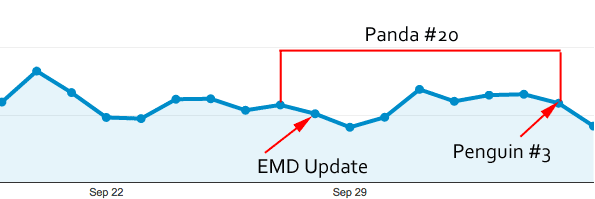
In the past week or two there have been some pretty major updates taking place at Google. So it can be confusing trying to figure out if you were negatively or positively impacted by one or more of these updates. Here is what happened:
Here is a chart to try to help you understand it:
Google Updates: September - October 2012
The Panda algorithm update really throws everything off and makes things pretty confusing.
There is a lot of chatter and discussion around the Penguin update but I am not sure if webmasters can pinpoint it to Penguin or Panda here.
In any event, I hope you did better after all these updates.